In the world of mining and industrial material handling, transfer chutes play a crucial role in maintaining smooth and efficient operations. While many manufacturers offer similar products, it is the uncompromising standards of Weba Chute Systems that sets this South African-based OEM apart.
With a dedicated focus on design, engineering and manufacturing, Weba Chute Systems has elevated the science of transfer chutes, providing customers, both in Africa and overseas, with unparalleled peace-of-mind and reliable solutions.
Contrary to common misconceptions, transfer chutes are not mere platework commodities that any general fabricator can produce on demand. Dewald Tintinger, Technical Manager at Weba Chute Systems, stresses the danger of adopting such an approach. “Generic chutes often result in suboptimal performance, unreliable operation and a lack of technical support when it is most needed,” he cautions.
“At Weba Chute Systems, every transfer point solution is custom-engineered to address specific material and operating conditions on-site. We leverage our extensive design capabilities and field experience in the process and our skilled draughtsmen employ the latest specialised software to model material flow accurately,” he says. “This meticulous approach ensures the optimisation of material trajectory, minimising impacts and disruptions during transfer.”
Further to this, he affirms that Weba Chute Systems takes pride in standing behind every chute produced. The company offers technical backup and support, ensuring that Weba chutes deliver consistent and reliable performance. “Our specially-trained technicians undertake regular inspections ensuring that proactive maintenance can be done, and where necessary customers can be forewarned regarding any issues. This approach enables informed decisions to be made and eliminates costly downtime due to premature chute failure.”
Tintinger emphasises the importance of involving transfer point specialists in the early stages of plant planning and design. “Our team’s experience and detailed knowledge of how transfer points and chutes work allow them to offer valuable guidance on positioning equipment for optimal material flow. By strategically placing chutes and other equipment, plants can significantly improve efficiency, resulting in enhanced production outcomes and cost savings.”
“While transfer chutes may be perceived to be relatively low-cost items within the overall process equipment flowsheet, these can become sources of significant and expensive operational problems when not properly engineered or maintained,” he continues. “We offer a solution to this issue by ensuring that our chutes are designed and installed to minimise disruptions and prevent costly downtime.”
“We believe that by prioritising reliability, technical support and early engagement in the planning stages, Weba Chute Systems empowers its customers with the tools they need to achieve smooth and efficient material transfer operations,” Tintinger concludes.
As mining companies embark on brownfields initiatives to meet rising market demand for battery and other minerals, the optimising of transfer points presents a valuable opportunity to deliver more output cost effectively.
Alwin Nienaber, Technical Director at Weba Chute Systems, says that when correctly used technology and experience provide a powerful combination when expanding production capacity. Technology can be leveraged to facilitate rapid and accurate scanning of the existing configuration of infrastructure into which the improved chutes are to be installed. Further, he says, the company brings a wealth of expertise to advise on valuable adjustments in the relationship between chutes and other equipment.
Alwin Nienaber, Technical Director at Weba Chute Systems.
“Custom engineered chutes and transfer points have been shown to facilitate smoother flow of mined material, with greater reliability and uptime for a more streamlined and productive operation,” explains Nienaber. “The initial focus when providing transfer point solutions to a brownfields project is usually to take careful note of the physical layout so that chutes are designed with spatial constraints in mind.”
This can be most accurately and efficiently achieved using 3D laser scanning of the existing layout, to rapidly gather detailed measurements of large infrastructure on a customer’s site. Using this data, a precise 3D model can be generated on the basis of which the necessary chutes and componentry can be designed and manufactured.
“This aligns well with Weba Chute Systems’ considerable in-house expertise in chute design, as each chute we build is unique to the application it serves,” Nienaber says. “It is important to remember that every transfer point exists in a relationship to other equipment, such as a screen, crusher or conveyor belt.”
Weba Chute Systems Technical Manager, Dewald Tintinger, using the 3D laser scanner to take dimensions on site.Central belt loading being discharged from a Weba chute at a steel plant in Turkey.Weba chutes installed at a steel plant in Turkey.Weba chutes, with samplers, installed at a steel plant in Turkey.
He highlights that an understanding of this relationship will underpin the productive application of transfer point design and installation. Indeed, while the 3D scanning and modelling technology provides a valuable starting point for design there is also scope for added improvements in the plant layout.
“On so many of the sites that we visit and assess, we can soon identify where changes in the relationship between the transfer points and other equipment can deliver better results,” says Nienaber. “While it is sometimes difficult – even costly – to implement some of these changes, the customer reaps many times the value in terms of uninterrupted volume flow, uptime and productivity.”
The first prize when installing transfer points, he emphasises, is always the optimal solution – which may mean reconsidering the position of the upstream and downstream equipment. In fact, this is always the starting point for Weba Chute Systems’ transfer point solutions: to achieve the most productive result for the customer.
“With our engineered design approach, we always consider the context of where our chutes are going to operate, and our decades of field experience allow us to advise the customer what will work best,” he says. “We might advise on how adjusting the position of a conveyor’s head pulley, for instance, would improve chute performance and overall plant efficiency.”
He notes that, while certain configuration changes might exceed budget constraints, the company’s intervention often allows for positive modifications to be made. A recent example of this was in a contract for a South African iron ore producer in the Northern Cape. Weba Chute Systems was asked to address the mine’s challenge where an existing competitor’s chute needed attention every two days which was severely hampering production.
“We designed and installed the optimal customised chute, but also recommended some related adjustments,” he says. “The design was a split chute, and the plant needed to speed up its conveyor quite considerably – as well as lifting the head pulley slightly – to achieve the necessary results.”
The changes recommended had financial implications, so the customer required considerable certainty that the solution would be successful. To underpin its plan, Weba Chute Systems digitally modelled the proposed design and simulated its operation using software that visualised the movement of material through the chute.
“Used by our skilled designers, this powerful software delivers more than a pretty picture,” emphasises Nienaber. “The simulation presents in video format exactly how equipment will be positioned and how material will flow through the system.”
Fundamental to these kinds of solutions, of course, is a close collaboration with the customer, built on a high level of trust in the company’s past performance. Aligned to this is Weba Chute Systems’ commitment to see through any project it embarks upon, he says.
“Our customers know we never walk away from a project – and this is an important factor in brownfields projects where one is often working within existing constraints rather than a clean slate,” he argues. “We have confidence in our people and our designs, and remain accountable for any solution we provide until it performs to levels we have promised.”
Another important factor in many projects is the level of degradation of mined material, which the company prides itself on reducing through its scientific, streamlined approach to the dynamics of bulk materials handling.
“An example of where this was important was a steel plant in Turkey where we installed a number of our chutes,” he explains. “The customer required minimal ore degradation, and even monitors the ore passing through each chute to ensure fines generation is kept to a minimum.”
Weba Chute Systems was required to incorporate samplers in its installations in this plant, and these samplers generate the data to verify the chutes are performing to expectation. The company’s custom design allows greater control over the direction, flow and velocity of material, whose volume and characteristics are specific to each application.
Custom engineered chute systems have significantly reduced dust levels while increasing productivity at Zimplats. Over the last two decades, Weba Chute Systems has installed 99 of its tailormade transfer points in various applications across the mine and processing plants.
Showing a rendered image of the transfer chute at the conveyor underground decline conveyor.Showing a rendered image of the crushing discharge transfer chute.Showing a rendered image of the crushing station vibrating primary jaw crusher transfer chute.Showing a rendered image of the crushing station vibrating grizzly transfer chute.
These bespoke installations span various applications including conveyor onto conveyor transfer chutes, apron feeder discharge chutes, mill feed chutes, conveyor onto bins transfer chutes, screen over and under size chutes, silo chutes, and transfer chutes at the crushing and screening stations.
Weba Chute Systems recently secured another contract to provide ten custom-engineered transfer chutes for the expansion of an underground crusher station at Zimplats.
Izak Potgieter, Systems Manager at Weba Chute Systems.Ted Cruickshank, Project Manager at Weba Chute Systems.
Ted Cruikshank, Weba Chute Systems’ Project Manager, explains that these chutes will handle the transportation of run-of-mine material from the ore pass to the underground crusher and from the crusher to the outgoing conveyor. He says the engineering and construction of these chutes will ensure a fit-for-purpose robust solution with the height of the chutes ranging from two to six metres.
Sharing specifics, Cruikshank say that the chutes before the crusher are designed to manage large material up to 650 mm in size from a vibrating feeder, with a maximum tonnage of 1,100 tph. “Other chutes will transport the feeder’s undersize, less than 180mm in size, at 550 tph, while still others will be employed in conveyor-to-conveyor applications, feeding 1,500mm wide belts with up to 1,350 tph of material and a maximum lump size of 250mm.”
Weba Chute Systems’ unique chute design philosophy, based on the cascade system, extends the wear life of the chute through the strategic placement of dead boxes, creating a layer of ore for the moving material to flow over. Replaceable lips are incorporated on the dead boxes facilitating easy and quick swap out at the necessary intervals. Easily accessible inspection doors are also a feature which will ensure maintenance becomes an effortless process.
Cruikshank says that this design has proven particularly effective at Zimplats due to the abrasiveness of platinum ore, and the Weba chutes will continue to ensure the smooth, controlled flow of mined and crushed material, leading to less wear, damage and spillage on conveyor belts and a marked reduction in dust.
Weba Chute Systems’ innovative design has been particularly effective in reducing dust levels. Izak Potgieter, Systems Manager at Weba Chute Systems ,cites the example of the bunker discharge chutes.
“In this application considerable dust levels were created due to material of up to 500 mm in size moving through the conventional transfer point at a rate of 600 tph with no control of the material result in an uneven flow creating a lot of energy for dust particle to expand into the surrounding atmosphere.”
Following the replacement of the conventional transfer point with a custom engineered Weba chute dust levels were considerably reduced by about 40% and Potgieter explains that by controlling the velocity of the material it is not only possible to reduce dust generation but also to improve flow control reducing impact and wear which in turn minimises maintenance downtime.
Hilmax, Weba Chute Systems’ local agent in Zimbabwe, will oversee the chute installations and provide spare sets of wearing lip liners for each chute to ensure optimal uptime for Zimplats.
Weba Chutes Systems, a leading local manufacturer of custom engineered chute systems, has secured a contract to supply four chutes to Sibanye-Stillwater’s Marikana operation in South Africa. These systems will replace existing conventional chutes that have been underperforming and failing to meet the required standards set by Sibanye-Stillwater.
Render from the 3D scan data taken during the site survey showing the relationship between the current equipment on site.
The four surge bin discharge chutes supplied by Weba Chute Systems will be responsible for feeding UG2 ore with a chrome content of 25% onto a vibrating feeder at the Marikana operation. The vibrating feeder operates at a peak capacity of 250 tons per hour, conveying fines with a maximum lump size of 90 mm and a bulk density of 3.8t/m³.
According to Dewald Tintinger, Technical Manager at Weba Chute Systems, the existing conventional chutes at the concentrator had been causing frequent blockages as well as exhibiting high wear, both of which was unacceptable. “As always when faced with such situations our objective is to custom engineer a chute system that will address these issues and consistently perform according to the required specifications in the long term,” he says.
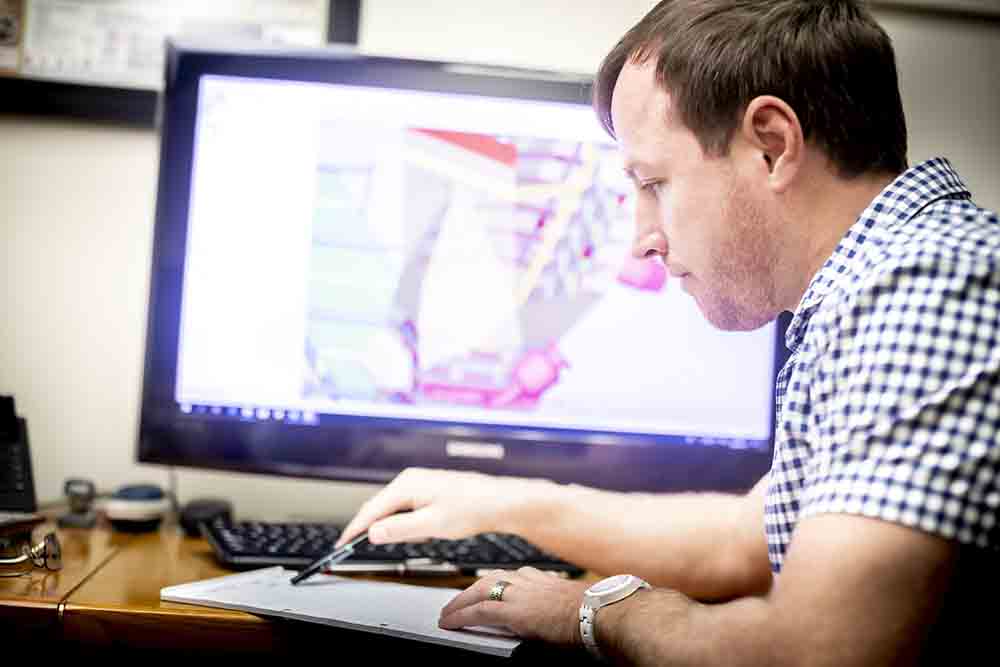
Showing an engineer in the process of designing a Weba transfer chute.
These Weba chutes will be manufactured from 6 mm 350 WA mild steel plate, and will incorporate Weba chute quick release lips for enhanced efficiency.
Tintinger says that Weba chutes are renowned for their reliability and durability under the most demanding operational conditions with a typical lifespan of up to 10 years in the field. Many installations have, however, surpassed this lifespan, continuing to deliver optimal performance.
“We continue to receive worldwide recognition for the unique Weba chute concept which is based on the principle of material impacting on surfaces that already contain material, ensuring efficient material flow,” he says. “One of the key requirements in transfer chute design is guiding and controlling the material throughout the system and we achieve this by leveraging our cascade or “supertube” concept, which ensures material-to-material contact at all times. Our chutes are engineered to precisely control the direction, flow and velocity of conveyed material, considering factors such as belt width, belt speed, material sizes, shape and throughput.”
Weba transfer chutes being fabricated at Weba Chute Systems’ facility in Germiston.
By creating this cascade effect, the generation of dust and fine particles during material transfer is significantly minimised leading to a marked reduction in unwanted dust and noise pollution with associated improvements in health and safety.
Achieving the correct and appropriate chute design is crucial, and Tintinger emphasises that the company doesn’t just simply manufacture chutes. “We assess both current and historical data to fully understand the specific requirements and this enables us to identify the critical factors that need to be addressed for a specific application.
“Weba Chute Systems has seen remarkable growth and this further solidifies our position as an international market leader in this field. This statement is also underpinned by the increasing number of retrofit projects we are currently undertaking which indicates that conventional chutes often fail to meet expectations,” he says.
Tintinger attributes this to the prevailing belief that chutes are merely platework. Leveraging innovative technology, Weba Chutes Systems established the benchmark for custom engineered transfer points that address the inherent limitations of conventional chute design.
While Weba chutes have primarily been applied in the mining industry for the transfer of materials such as copper, gold, iron ore, diamonds, coal and platinum, the company has noted a growing demand from other sectors including aggregates and sand quarrying, power generation, steelmaking, cement production and food processing.
Handling sticky material in mining and minerals processing plants can be a complex challenge. These materials can cause blockages, equipment wear and increased maintenance requirements, leading to reduced efficiency and increased operational costs.
This is according to Alwin Nienaber, Technical Director at Weba Chute Systems, who says that designing transfer points to effectively handle sticky materials is crucial for optimising material flow and minimizing downtime. “There are a number of key design considerations for transfer points and it is for this reason that EPCM contractors and end-users should work closely with specialist companies such as ourselves who have the requisite expertise and legacy knowledge to deal with complicated materials transfer.”
An important consideration is material flow control, which Nienaber explains is crucial to avoid blockages and build-up of sticky materials within chute systems.
Transfer chute designer is seen meticulously scrutinising calculations with the aim of ensuring a highly efficient and viable solution.
“This is where chute geometry plays a significant role in handling sticky materials, with experience informing the design of a chute to minimise impact forces and reduce material degradation. Minimising is also important, and this can be achieved through the use of wear-resistant materials such as ceramic tiles or rubber linings, and further extend the service life of transfer points while reducing maintenance requirements,” he says.
Nienaber says it is also important to control moisture levels when handling sticky materials. Excessive moisture can exacerbate the stickiness of materials, leading to increased build-up and blockages. Implementing moisture control strategies, such as proper drainage systems, dust suppression or material conditioning systems, can help maintain optimal moisture levels and improve material flow.
Material segregation and excessive particle size can also contribute to sticky material challenges at transfer points. This, he says, is where implementing strategies to minimise material segregation, such as proper stockpile management and the use of blending systems, can help maintain consistent material properties.
“Additionally, reducing particle size through controlled crushing or screening can help improve material flow and reduce the stickiness of the material,” Nienaber adds.
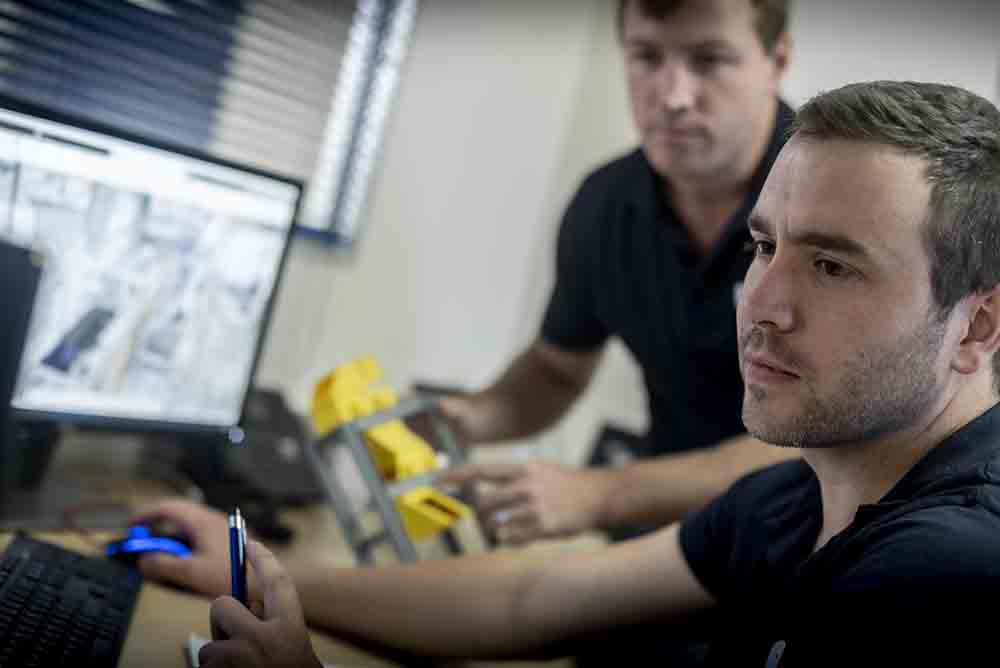
Designers are carefully scrutinising 3D scanned data in comparison to their initial design.
Viewing transfer points holistically should also include attention to other aspects in materials handling such as belt cleaning systems which are vital for preventing carryback and will also reduce material build-up at transfer points. Installing primary and secondary belt cleaners, along with belt tracking systems, can ensure that belts are free from sticky material carryback. This not only reduces the chances of blockages but also minimises belt wear and extends belt life.
“Implementing well-thought out design strategies from an experience transfer point OEM can certainly assist mining and minerals processing operations to optimise material flow, reduce equipment wear and maintenance requirements, and ultimately improve overall efficiency and productivity,” Nienaber concludes.
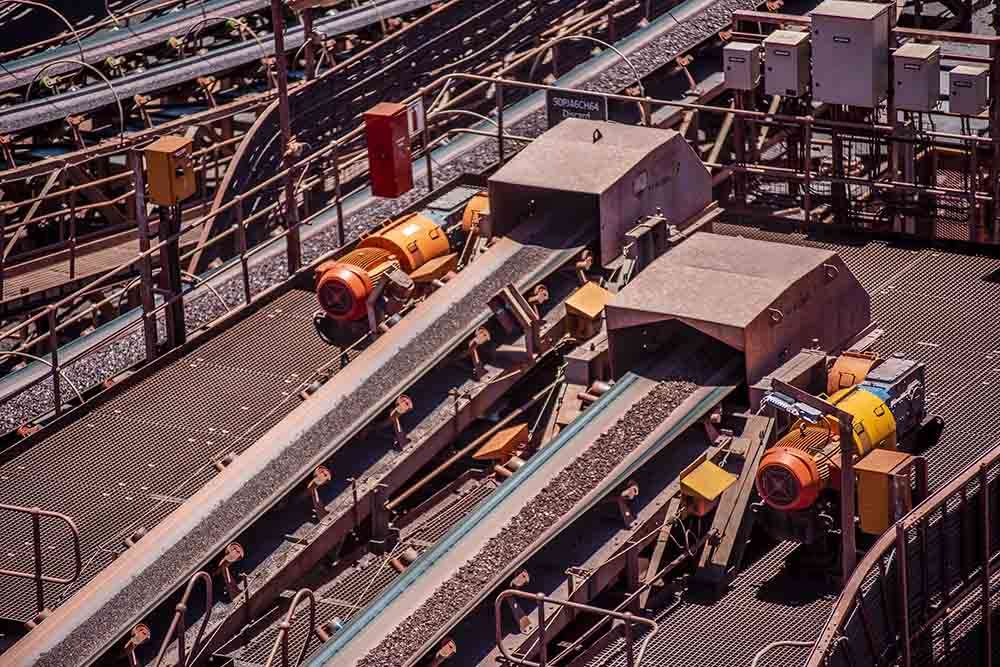
The efficient transfer of iron ore is being executed by two Weba head chutes.
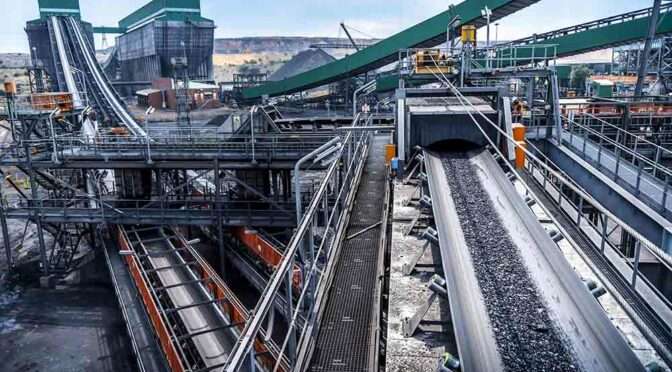
The generation of coal dust around conveyer systems and transfer points is a problem for operators of coal mines, coal plants and similar facilities. Coal dust is a contributor to lung disease and it therefore poses a threat to not only workers in these facilities but even to residents of neighbouring communities. It also poses a safety hazard, as it can spontaneously ignite causing potentially life-threatening fires.
Coal dust also impacts on the efficiency of coal handling systems – and hence productivity and profits. Equipment and machinery can become thickly coated with dust, which increases the need for regular cleaning, while dust ingress into moving machinery reduces its lifespan.
To control the problem, reliance is generally placed on dust suppression and dust extraction systems. While this all well and good, there is a tendency to over-rely on these systems, which results in them doing more ‘heavy lifting’ than they need to and often more than they can manage.
Visual inspection of a transfer chute underway.
According to Alwin Nienaber, Technical Director of South Africa’s Weba Chute Systems, a globally recognised leader in chute technology, a more effective approach is to focus on the engineering and positioning of the transfer chutes that form an integral part of most conveyor systems.
“This can relieve 50 to 80 % of the problem,” he says. “Suppression and extraction of the remaining dust then becomes a much more efficient component in a broader and more holistic solution.”
He adds that at the heart of any effort to control dust is an understanding of material flow and of the effects of uncontrolled velocity and impact. As he says, “Dust is really just one of a number of unwanted consequences of a lack of control over material flow, including degradation of the material being moved.”
Reinforcing this point, Nienaber’s colleague, Dewald Tintinger, Technical Manager at Weba Chute Systems, notes that most chutes simply provide an open channel for material to fall through, before being discharged onto the next conveyor or outlet. The result is that material can spread in an uncontrolled manner as it travels, which invariably creates much more dust than is necessary.
Tintinger says Weba Chute Systems can provide custom-engineered chute designs which deliberately create a flow path for the material based on its inherent qualities, speed and volume and the throughput requirements of the installation.
Screen underpan onto a conveyor transfer chute at a coal mine in Limpopo.
“Using sound engineering principles, chutes can be designed to minimise the physical impacts that create dust,” he says. “We base designs on the ‘supertube’ effect, allowing controlled transfer of material onto the conveyor belt. This also reduces wear and tear on the belt.”
To allow it to model the behaviour of material being transported via conveyors and chutes, Weba deploys specialised technology including three-dimensional software. It also verifies its designs prior to manufacture using discrete element method (DEM) simulation.
As a final point, Nienaber says that strategies to control coal dust are best formulated at the design stage and that the earlier Weba Chute Systems is involved, the better the outcome.
“The configuration or general arrangement of equipment within a plant or between structures is important,” he maintains. “In our experience, we have seen the benefit of being able to advise plant designers on the optimal positioning of chutes and related equipment at the planning stage. The result is invariably a sharp reduction in dust creation and a more efficient flow of material.”
A screen underpan onto a conveyor transfer chute at a coal mine in Limpopo being inspected by Weba Chute Systems personnel.
When a new plant is being planned, considerable care needs to be taken in the design and placement of the transfer chutes, argues Mark Baller, managing director of Weba Chute Systems.
“In our experience, there has been considerable disruption caused to plant operations by transfer chutes which are not optimally designed or properly located in the flowsheet,” says Baller. “This is a concern, as this disruption can cause financial loss that is not commensurate with the value of the equipment.”
Conveyor feeding material to a Weba cascade head chute.
He says the relatively low cost of a chute compared to the high value items like crushers and screens may be one reason why they are not taken as seriously as they should be. For example, the chute supplier is often engaged quite late in the plant design process.
“The plant layout has then already been decided, and the chutes are just expected to be slotted in as and where the space is available,” he says. “We request our clients to talk to us earlier, so that we can give the necessary valuable input on where chutes would be best placed. It is costly and time consuming to try and adjust plant designs further down the line.”
Conveyor feeding material to a Weba cascade head chute.
It is even more costly to make changes after the plant is built and is then found to experience challenges at the transfer points. This may even require complex modifications such as moving the head pulley or changing structures and flows to allow for a different flow path.
“Nonetheless, we have developed a reputation for success even in these difficult situations,” he says. “We helped an Australian iron ore mine which was having to shut its plant down every six weeks due to problems with its transfer chutes.”
The mine needed to extend its chute maintenance window from six to eight weeks, so Weba Chute Systems engineered a solution for their challenging ore – which was sticky when wet. This was achieved, with maintenance interval in fact being lengthened from six to 12 weeks.
“Our improvements meant that the transfer chutes were lasting longer than the other equipment, and were no longer an obstacle in the mine’s strategy to reduce the number of shutdowns each year,” he says.