BOOYCO ELECTRONICS EXTENDS FOOTPRINT WITH STRATEGIC COLLABORATIONS

South Africa-based proximity detection specialist Booyco Electronics is broadening its global reach through collaboration agreements with selected technology integrators.

Solutions from Booyco Electronics, a pioneering force in proximity detection systems (PDS) and collision avoidance, have been attracting increasing international interest, says CEO Anton Lourens. The company has been applying and improving its technology mainly in the mining sector for the past 15 years.

“With South Africa’s mining industry in many respects leading the way in deploying collision avoidance systems, Booyco Electronics has developed world class solutions that can add value to global markets,” says Lourens. “Having explored the best ways of servicing our international customers, we have chosen a number of strategic collaborations with technology integrators across the world.”

The company now has collaborations with several technology specialists worldwide including Insucam, Ramjack, RCT and Tecwise. These partners understand the safety and other benefits of Booyco Electronics’ PDS solutions, and bring their insights into the local conditions in which this equipment can be applied.

“We believe that these technology partners – who understand our products and solutions – create the optimal channel to customers in regions where Booyco Electronics does not have its own infrastructure,” Lourens says. “These companies understand their customers’ specific needs, and can apply our solutions in the most effective manner.”

He highlights that collaborative partners are expected to have high levels of expertise in related fields, a solid technical capacity to support customers, and the necessary insight and experience to implement value-adding solutions.

“Their role in applying our PDS solutions would include the full scoping of customer needs, close engagement to clarify options, training of customers’ operators, installation of equipment and general project execution,” said Lourens. “This gives the customer confidence that our solutions will be properly leveraged to satisfy requirements.”

“We appreciate the fact that new technologies like ours are easier to introduce through an existing relationship – for instance, where a mine has already been working successfully with a trusted technology integrator,” he says. 

“Our approach is therefore to build on those links where confidence has already been built, based particularly on the delivery of innovative solutions.”

The company’s partners are therefore best placed to facilitate Booyco Electronics’ access into markets not yet familiar with PDS.

MANAGING CONSTRUCTION WASTE IS PART OF GREENER FUTURE

Climate change is now everyone’s concern, and black women-owned construction leader Concor’s efforts to operate more efficiently and sustainably include the way it deals with its construction waste. 

According to Leah Nwedamutswu, quality assurance and quality control (QA/QC) officer at Concor, the company’s commitment to Zero Harm embraces staff, the community and the environment. Growing awareness of climate change imperatives has led the company to develop performance strategies to carefully manage water use, energy consumption and process waste. 

“This includes preventing pollution emanating from our industrial processes, which means spreading this message to all staff and subcontractors on our project sites,” says Nwedamutswu. “Our critical environmental standards are in place, and we actively assess and manage our risks and opportunities.”

The environmental management plans (EMPs) and authorisations of Concor’s clients are also embedded in the daily work processes, ensuring that the company can play its role in supporting the client’s compliance responsibilities. 

This commitment has recently been expressed by Concor at its projects in the Oxford Parks mixed-use precinct in Rosebank, Johannesburg, where it is proceeding with its sixth Green Star-rated building. Nwedamutswu highlights the company’s waste hierarchy system, which it has applied over the years to ensure that waste is effectively reduced, reused and recycled. 

“We have a detailed and ongoing focus on the natural resources that we consume in construction, and recognise that these are finite and precious,” she says. “The care with which we manage our waste also enhances health and safety on site.”

The waste management system prioritises separating the waste at source, and dedicates human resources to ensure that building rubble, wood, steel or plastic is properly sorted and placed in the right containers or skips. This prevents contamination of the various waste streams, allowing each stream to be more efficiently and cost effectively recycled.

“Implementing our system requires both discipline and education, especially as we employ many smaller companies as subcontractors, who may not initially give the same priority to environmental protection,” she says. “We therefore actively communicate our policies and requirements, and expect our partners on site to be as serious about waste management as we are.”

Specialised recycling service providers play an important role in Concor’s waste management supply chain, as they help to optimise the levels of waste that can by recycled. 

Dumping in landfill is considered an absolute last resort, and this must be kept to a minimum. Even building rubble can be pulverised and re-used in certain applications, as long as it is not contaminated by other materials. 

“Our strict policies require that we also monitor the integrity of our waste supply chain, to confirm that the various streams of waste actually go where they are supposed to,” says Nwedamutswu. “This is done by double-checking the weighbridge documentation we receive from our waste service providers, and these must match our own records of waste leaving the site.”

GRUNDFOS RAISES THE BAR FOR WASTEWATER TREATMENT

As conserving water and maintaining high water quality become increasingly critical issues for South Africa, wastewater systems will need to perform more reliably and safely.

According to Bennie Thiart, Grundfos sales director water utility South Africa, the Grundfos SE/SL range of wastewater pumps are now fitted with the Open S-tube® impeller for greater durability and reliable performance. 

“As the level of solids in our wastewater rises, this innovative pump design can make wastewater plants and pump stations much less susceptible to stoppages and overflowing,” says Thiart. “Our design allows even stringy material like rags to be passed quickly through the pump without causing a blockage or shutdown of the motor.”

He highlights that wastewater treatment plants and pump stations operated by municipalities or industry can cause considerable environmental harm when they overflow due to pump stoppages. When there are unexpected disruptions to pumping, waste water can flow into rivers and wetlands – that leads to contamination of groundwater aquifers.

“We can expect stricter enforcement of environmental legislation, as South Africa’s water resources are currently under pressure,” he says. “Wastewater treatment plants, for instance, can no longer afford the risk of spillages.”

The Grundfos SE/SL range with its semi-open hydraulic design will equip these facilities for higher levels of performance and operational security. The first generation of these pumps has been well received in southern Africa since the early 2000s, he says, and the market is ready for these added features. 

“Our development of the latest generation technology first required extensive virtual simulation,” he says. “We then spent the past two years testing actual prototypes in the field and the results have been up to our expectations.”

Hydraulic performance tests on the SE/SL range have followed the ISO 9906 standards, among others, while clogging tests are conducted according to the methodology developed by the Technische Universität Berlin. 

Critical to the design is the quick expulsion of solid material and objects from the pump, to avoid raising the torque to levels that will trip the motor. This functionality can be enhanced by fitting a guide vane to the pump. 

Pump performance can be remotely tracked with a Grundfos monitoring and control system, which can also generate early warning signals for operators in case of any changes in the operation of the pumps. 

“With their improved durability and reliability, these pumps certainly give operators of wastewater treatment plants more peace of mind,” says Thiart. “We also have a depth of in-house expertise – both locally and globally – to assist with pump station design and pump selection to ensure fit-for-purpose solutions.”

HIGH-TECH REVOLUTION OPENS DOORS FOR ON-SITE MINE TRAINING

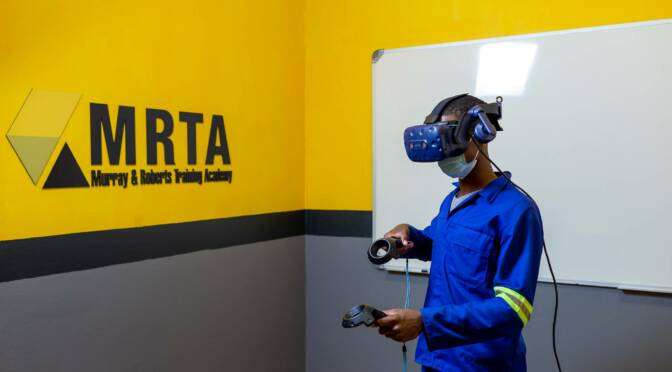
In a quantum leap for training in the underground mining sector, the Murray & Roberts Cementation Training Academy (MRTA) is strategically positioning itself to take its world class learning systems to customers on their own sites.

This innovative move, according to Murray & Roberts Cementation education, training and development (ETD) executive Tony Pretorius, incorporates the use of remote e-learning solutions coupled to Dover Assessment for psychomotor skills, VR Simulation, mass assessment tools and classroom response systems – or ‘clickers’. 

“It is an exciting step beyond the MRTA’s industry-leading facilities at Bentley Park near Carletonville, and opens doors for companies to generate and upgrade skills even during the Covid-19 pandemic”, Pretorius says.

“Making use of the latest technologies – such as interactive touchscreens – we can now offer two-dimensional and three-dimensional training interventions,” he says. “This can be deployed with virtual reality (VR) training modules, including the use of VR simulators that we are developing with our strategic technology partner, Simulated Training Solutions (STS).”

Among the high-tech advances being driven by the academy is a portable VR drill rig. The portfolio of ground-breaking training tools will be easily transported in a purpose-designed trailer to sites convenient to the customer – even on mines themselves. 

Applying the tools, he says, will be members of MRTA’s experienced team of trainers, accredited by the Mining Qualifications Authority.

“This gives even remote mining sites the chance to enhance skill levels, productivity and safety,” he says. He points to the ongoing difficulty that companies face in conducting group activities under Covid‑19 protocols, and particularly in moving personnel across borders. 

In addition to these regulatory restraints, this new training infrastructure could also reduce the cost of having staff attend off-site training for extended periods – where costs are raised by travel and accommodation.

“We believe that our state-of-the-art educational innovations can give remote mines unprecedented access to valuable skills transfer with real bottom-line benefits to be gained,” he says. 

Looking beyond mining operations themselves, Pretorius also highlights plans to reach out to communities needing skills development to combat unemployment. This socially responsible approach to training is already embraced at the MRTA facilities, but could in future be more widely available through this injection of technology. 

The academy’s new age of training systems will also be rolled out within the projects of Murray & Roberts Cementation itself, further enhancing the company’s reputation for performance excellence and safety. 

“This new technology definitely raises the level to which we can take industry skills, and we anticipate an enthusiastic response from both internal and external clients,” says Pretorius. “We believe strongly that this is the future of training – where we leverage digital technologies like VR to help take mining expertise into the Fourth Industrial Revolution.”

KWATANI INNOVATES TO KEEP SCREENS WELL ISOLATED

Process plant designers often underestimate the movement of large vibrating screens when these machines start and stop, a challenge for which Kwatani has found an innovative and cost effective solution.

According to Kwatani’s chief operating officer, Kenny Mayhew-Ridgers, the company has achieved considerable improvements in many screening applications by selectively fitting torsional springs alongside coil springs. 

“It is well known that the vibrating motion of a screen impacts on the building and structural accessories around it,” says Mayhew-Ridgers. “This vibration is addressed by fitting isolators between the screen and the plant floor, and by constructing the plant building to certain minimum structural specifications.”

However, the focus is often on the frequencies that the screen generates in its steady-state phase – or the normal running phase – rather than during the transient phases when the screen is starting up or slowing down to a stop.

He highlights that it is during these transient phases that the screen’s movement becomes amplified and potentially most destructive. Isolators between the screen and the floor – common among which are coil springs and rubber buffers – are meant to absorb vibrations and prevent damage to surrounding infrastructure. However, the transient phases, especially when stopping, can generate considerable sideways movement of the screen, which must be avoided.

“Traditional isolators like coil springs usually perform well in controlling the up-and-down movement of the screen,” he says. “Our experience is that the sideways movement, which is induced most strongly when the machine stops, can be better controlled by torsional springs.”

However, he notes that coil springs retain the advantages of being cost effective and providing a good linear isolation of the screen from the building structure. In this respect, their isolation characteristics are generally better than rubber buffers which rather excel in terms of their damping qualities. 

“The torsional spring provides the best of both worlds, giving a good linear range for compression during operation while also becoming non-linear like the rubber buffer during stopping,” he says. 

Using its years of experience observing screens operating in the field, Kwatani has developed and trialled various solutions in its dedicated testing centre at its headquarters in Kempton Park. By optimising the best combination of coil springs and torsional springs, the company has succeeded in achieving the best results for customers. 

“It’s not that torsional springs are better than coil springs,” said Mayhew-Ridgers. “It is about finding the right combination – through intensive testing and adaptation – for the customer’s particular requirements; we have both the expertise and the equipment to do this.”

UNPRECEDENTED DEMAND FOR GRINDEX STAINLESS STEEL PUMPS ON COPPERBELT

Integrated Pump Technology reports an unprecedented demand for Grindex stainless steel pumps from customers on the Zambian and DRC Copperbelt. Recent months have seen the company replace cast iron and aluminium pumps with these units across a range of operating applications, and on remote mines in this region. 

Sales manager, Jordan Marsh attributes the move to stainless pump units to the poor water quality in the region which has seen acidity levels increase and pH drop. “In areas experiencing acid mine drainage, we see many instances where initial pumps selection did not properly consider the operating conditions, and excessive strain was placed on pumps that are not practical for use in such highly corrosive applications.” 

“This is one of the reasons why we urge our customers to do a proper assessment of the operating environment and ensure that the pump selected is capable of dealing with conditions,” he continues. 

Marsh stresses that a standard submersible drainage and sludge pump, even with a protective coating, is not able to withstand the levels of acidity and abrasion and will fail within a matter of weeks or even days. 

“As the official sub-Saharan distributor for Grindex pumps, we are able to offer Grindex stainless steel pumps which are engineered to operate reliably in contaminated water and handle corrosive slurries with abrasive solids.”

A major advantage that the Grindex Inox range of pumps offers is that that these are essentially plug and play units and easy to install and operate. The pumps are manufactured from acid-proof stainless steel and operate reliably in pH levels ranging from 2 to 10. This makes the pumps more than suitable for use in mining applications on the Copperbelt. 

“What sets the Grindex Inox range apart from other similar stainless steel pumps is that it incorporates SMART motor protection,” Marsh explains. “This facilitates pump operation without requiring an external control panel and prevents damage being caused in the event of a power outage.” 

The cast acid-proof stainless steel impeller ensures pumping capacities in corrosive slurries, while the diffusers in the drainage pumps are rubber-lined and adjustable to maintain optimum pumping performance. In the sludge pumps, the rubber-lined pump housing is highly abrasive resistant and oil-resistant for longer life. 

Included in the Grindex pumps recently installed and operating successfully on the Zambian and DRC Copperbelt are dewatering, drainage and sludge pumps ranging from 2 kW all the way up to 8 kW units as well as 85 kW Grindex N/H stainless steel Inox pumps. 

AFRISAM’S ROCK SOLID FOUNDATION FOR QUALITY AGGREGATES

With a heritage spanning more than eight decades, AfriSam’s footprint of quarries nationwide is supported by quality systems that ensure customers reliability and consistency of aggregate supply.

“The value of the right aggregate for the task cannot be overstated, as it affects all aspects of project success – from safety and longevity to cost-effectiveness and reputational risk,” says Amit Dawneerangen, general manager sales and product technical at AfriSam. 

The company’s strong product technical department ensures that all facilities and products comply with the necessary standards and quality specifications. Standard quality control testing is conducted regularly on each aggregate stockpile at every operation, and annual testing is also conducted by independent SANAS-accredited laboratories. 

“This is all vital to assuring the customer that our aggregate helps them to meet the design engineer’s specifications for their contract,” he says. “Without these quality systems and processes, the construction value chain can be compromised and cause various negative impacts for stakeholders down the line.”

Glenn Johnson, general manager construction materials operation aggregates at AfriSam, highlights that ongoing planning and investment ensures that the company’s quarry reserves are in place for future sustainability. 

“There can be no quality aggregate supplied if there are not well-planned and compliant quarries to mine,” says Johnson. “We have therefore invested extensively in finding, licencing and establishing quarries with suitable geology and mineralogy; of course, these must also be close to markets – hence our wide national footprint.”

Based on these facilities, AfriSam’s range of offerings ensures that it can provide consulting engineers and contractors with every project requirement. According to AfriSam regional sales manager Shaughn Smit, this also means meeting the stringent demands of Committee of Transport Officials (COTO) and South African National Standards (SANS) specifications. 

“By applying the ISO 9001-2015 standards framework internally, and by applying our various quality systems at all our operations, we give customers peace of mind in terms of compliance and best practice,” says Smit. “We can provide this regardless of whether the aggregate application is in road building, readymix, concrete product manufacturing or asphalt production.”

This avoids the many risks that accompany the use of cheap, sub-standard aggregate, including its impact on the longevity and safety of structures, and the added maintenance and repairs required when structures fail prematurely. 

“Our focus on quality is cost effective as it ensures value for money over time,” he says. “It also means that contractors and their clients reduce the considerable reputational risk that project delays or challenges can cause.”

Dawneerangen says AfriSam’s depth of expertise and experience has made it a valuable partner to the consulting engineering sector, as it shares its knowledge and insights on the application of aggregate. 

“Especially with large and complex projects, our specialists are able to provide insights to assist project design at an early stage,” he says. “Where aggregates are specified for a project but are not available in the area, we can even step in to produce custom aggregates that suit customer needs.”

MINI-SUBSTATIONS FOR MOTOR PLANT BOASTS DRY-TYPE TRANSFORMER

Dry-type transformer specialist Trafo Power Solutions will supply two custom-engineered mini-substations to a significant motor plant expansion near Pretoria. 

The two units will be located outdoors, serving to power the lighting system and security requirements of the facility, as well as other loads. While most mini-substations are equipped with conventional oil-cooled transformers, these units have dry-type transformers – delivering a number of benefits to the customer. 

David Claassen, managing director of Trafo Power Solutions, says these include security and environmental factors.

“Used by both the private and public sector, mini-substations must often be located in unprotected areas, making them vulnerable to vandalism and theft,” Claassen says. “The oil-cooled transformers are often targeted for the copper in their windings, as well as the oil for the cooling system.”

The dry-type transformer’s windings, by contrast, are cast in resin so the copper or aluminium cannot be readily accessed. There is also no oil to harvest, further reducing the incentive for criminals to destroy the structure. 

“In terms of environmental considerations, the dry-type transformer does not require any additional protective structure like walls or bunds to contain leaking oil or fire,” he says. “These units also require very little maintenance, easing the managerial and technical burden on the owner.”

While these two transformers are manufactured in TMC Transformers’ world-class facility in Italy, the design and manufacture of the balance of the mini-substation is carried out in South Africa. This gives Trafo Power Solutions a high level of control over the quality of the final product, says Claassen.

“This also allows us to fully test the equipment locally before it is delivered, installed and commissioned on site,” he says. “We embrace the opportunity to manufacture locally as much as we can, to support local industries and enhance job creation.”