Tag Archives: AfriSam

‘DOING MORE WITH LESS’ TO MEET AGGREGATES DEMAND FOR N3 PROJECT

To keep up with the massive aggregates demand for the N3 national road upgrade project, AfriSam’s Umlaas Road Quarry has doubled its volumes using existing resources. The lean team on site is living up to its “do more with less” mantra. 

Part of government’s 62 Strategic Integrated Projects gazetted as part of the Infrastructure Investment Plan approved by Cabinet in 2020, the N3 national road upgrade – which focuses on an 80 km section from Durban to Pietermaritzburg – continues apace.

Located right at the doorstep of the very first package of the project – the 6 km stretch between the Dardanellas Interchange and the Lynnfield Park Interchange – Umlaas Road Quarry is playing a key role in keeping this vital national project ticking. 

The magnitude of the project has placed severe pressure on local construction material suppliers in the area. To provide context, the project required 300 000 tonnes of fill material per month for the past two years. However, the past few months have seen the demand scale tilting in favour of the ‘blue’ material, confirms Theolan Govender, Regional Manager overseeing the AfriSam Umlaas Quarry. 

From the onset, the team at AfriSam’s Umlaas Quarry has always focused its efforts on the ‘blue’ material, with AfriSam’s Pietermaritzburg Quarry, located some 30 km away, providing the necessary backup with the supply of sub-base material, including G2, G4 and G6. 

“Due to the sheer scale of the project, we had to more than double our pre-Covid volumes in 2021, maintaining the same feat in 2022,” says Govender. “A key talking point is our ability to push these massive volumes using the existing resources, thus transforming this small quarry into a big operation using a very lean team.”

To achieve this feat, AfriSam mobilised two existing trains of mobile crushers and screens (comprising eight machines in total) to complement the static plant. 

To maintain high plant availability on the old mobile trains, AfriSam has deployed a maintenance specialist who is well versed with mobile solutions. The stringent maintenance regime has already paid dividends; the team has managed to double the mobile plant’s availability, running at a 55% overall equipment effectiveness, which is quite extraordinary for these 20 year-old units.  

“Effective management of resources has been key to keeping up with the massive aggregates demand. The lean team at AfriSam’s Umlaas Quarry has demonstrated its ability to do more with less. This has been done safely and cost-effectively, which speaks directly to the team’s competence and commitment to the cause,” concludes Govender.

AFRISAM LAB STAYS OUT FRONT WITH SANAS THUMBS-UP

The specialised cement and construction materials laboratory at AfriSam’s Centre of Product Excellence (CPE) in Roodepoort, Gauteng, has once again earned the SANAS stamp of approval. 

The laboratory conducts in-depth testing and investigation across a range of processes and materials, according to AfriSam CPE Manager Mike McDonald. The critical role of concrete in the safety and sustainability of structures highlights the importance of the regular SANAS certification.

“Remaining certified within stringent SANAS requirements – which in turn align to international ISO/IEC 17025 management system standards – ensures that AfriSam’s laboratory is world class,” says McDonald. “Our quality processes mean that our customers can rely on us for the performance of their concrete, and we can continue to take forward AfriSam’s exciting product development innovations.”

He notes that the demanding recertification process is conducted every five years, ensuring that the latest international best practice is incorporated into the laboratory’s quality systems. A recent enhancement of the global standards – and applied in turn by SANAS – is its risk-based approach. The latest certification therefore has required AfriSam’s laboratory to consider and mitigate a range of risks factors. 

Among these is the risk of bias during the testing process, which is addressed by strictly protecting the anonymity of the test work, he explains. The laboratory uses a numbering system to ensure that analysts are not aware of the names of companies that submit samples for testing. 

“The recertification is by no means easy or simple, requiring extensive internal and external training of all our 22 laboratory personnel,” he says. “In maintaining these high standards, it is clear that our highly skilled staff are committed to our quality mission.”

The laboratory’s instruments, technology and skills complement make it one of the country’s most specialised facilities for testing cement and construction materials. Equipment includes a microcalorimeter for measuring heat from concrete samples, and instruments for thermal gravimetric analysis (TGA) for measuring material weight during heating. 

“The laboratory gives AfriSam enviable capability on various levels – from proving up our theoretical concrete mix designs for customers to investigating any challenges that contractors might be facing with their concrete on site,” says McDonald. “Our research and testing also provides innovative solutions for customers, such as reducing or removing the need for costly steam generation for curing concrete products.”

Being able to conduct laboratory-scale testing of new mixes is a significant advantage for customers like concrete product manufacturers, he points out. If they tested unproven mix designs in their production process, there could be considerable trial and error. This invariably produced wastage of material and labour time, whereas the laboratory could accurately predict results while not disrupting on-site production. 

He emphasises that cement testing remains a central focus of the laboratory’s work, including oxide analysis and testing for gypsum content as well as fineness and strength of cement. AfriSam relied heavily on the laboratory for its ongoing drive to reduce the carbon footprint of cement, allowing the development of a product with 40% less carbon impact than pure cement. 

“The SANAS recertification of our laboratory is an important foundation for the accuracy and reliability of all our testing and research work,” he says. “This assures customers and the broader industry of AfriSam’s ongoing commitment to quality standards that match the world’s best.”

AFRISAM CLICKTOGO OFFERS ADDED VALUE TO CUSTOMERS

ClickToGo, launched by AfriSam, South Africa’s leading construction materials company, is a gamechanger. This remarkable digital platform is a first of its kind in the construction industry and allows existing customers in South Africa to effortlessly order materials and manage their accounts, providing a seamless experience.

AfriSam’s ClickToGo, a new and remarkable digital platform, is a first of its kind in the construction industry.AfriSam’s ClickToGo, a new and remarkable digital platform, is a first of its kind in the construction industry.
AfriSam’s ClickToGo, a new and remarkable digital platform, is a first of its kind in the construction industry.

The user-friendly online platform, ClickToGo, was developed to provide a digital solution that would ensure convenience and take the customer experience to another level.

“Our goal is to prioritise our customers and drive progress in the industry, and ClickToGo, our innovative e-experience platform, will empower our customers and enhances their interaction with us,” Ilonka de Magalhaes, Customer Experience Manager at AfriSam, says.

ClickToGo offers a range of features designed for ease of use. Customers can easily view their orders, directly order from quotes, review their order history, access essential account documents and credit information and track deliveries effortlessly. Additionally, super users can assign different roles and permissions to staff, facilitating seamless collaboration within organisations.

Almost 70% of AfriSam’s 30-day account customers have already registered and actively use ClickToGo.

Launched in November 2021, ClickToGo has gained significant interest with positive feedback from customers. “We are delighted by the response to ClickToGo,” de Magalhaes says. “Almost 70% of our 30-day account customers have already registered and actively use the platform.”

It is important to note that AfriSam continuously refines and enhances ClickToGo’s functionality based on valuable feedback from customers and front-line employees.

A recent significant development on the innovative ClicktoGo e-platform is the inclusion of cash account customers, extending use of this platform for all account customers and ensuring all can benefit from this streamlined online ordering platform.

Enhancing the customer experience further, AfriSam has integrated ClickToGo with its Online Payment Gateway. Cash account customers can now conveniently place orders and make payments in a single transaction. “Our aim is to provide a smooth and hassle-free experience for our customers,” de Magalhaes emphasises. “We want to make the process as effortless as possible.”

Moreover, ClickToGo enables cash account customers to apply for a credit facility directly through the platform, simplifying the process and making it more accessible. At the same time, 30-day account customers now have the ability to request credit limit increases directly on the platform, ensuring a seamless and streamlined user experience.

AfriSam’s ClickToGo is a significant milestone in the company’s digital transformation journey, aligning with its commitment to delivering an exceptional customer experience. By offering convenience, effectiveness, and transparency, ClickToGo sets a new standard for the construction materials industry.

“We aim to redefine the customer experience and cement our position as an industry leader through this innovative e-experience platform,” de Magalhaes concludes.

AFRISAM’S COMMITMENT TO SAFETY: PROMOTING RAIL SAFETY AND SAVING LIVES AT LEVEL CROSSINGS

AfriSam, leading construction materials group, places safety at the forefront of its operations, acknowledging the importance of safeguarding its people and the communities within which it operates. As both a responsible employer and corporate citizen, the company’s unwavering commitment to safety extends beyond its own operations and into the realm of rail safety, particularly at level crossings, where road and rail networks  intersect.

Deputy Minister of Transport, Mr Lisa Mangcu, spent the early morning engaging with motorists and pedestrian at the AfriSam Ulco plant level crossing.

In collaboration with Traxtion, Africa’s largest private freight rail operator, and the Rail Safety Regulator (RSR), AfriSam was actively involved in promoting International Level Crossing Awareness Day (ILCAD) campaign in June 2023. This global initiative, championed by the International Union of Railways (UIC), unites railway communities from 28 countries raising awareness of level crossing safety.

AfriSam’s commitment to “Zero Harm” reflects its strong belief in prioritising the safety and well-being of its employees and the community. This informed the company’s contribution to ILCAD with its focus on recognising the potential risks and hazards associated with level crossings on a day dedicated to saving lives and preventing accidents.

Nathi Shoba, AfriSam’s Quality Assurance Manager, expresses the company’s resolute commitment to safety, stating, “This is all about saving lives, and for this reason, we were extremely proud to play our part in International Level Crossing Awareness Day (ILCAD).” AfriSam’s involvement in the campaign reflects its dedication to proactive engagement, education and fostering a culture of responsible behaviour at level crossings.

Deputy Minister of Transport, Mr Lisa Mangcu, addressing the learners of Ulco Primary School.

Madelein Williams, Executive: Media and Communications and spokesperson for the RSR in South Africa, emphasises their primary objective of enhancing rail safety, a goal that often faces challenges when motorists and pedestrians fail to adhere to level crossing regulations. Williams expresses concern over the recorded 47 injuries between 2020/21 and 2021/22, as this undermines the RSR’s efforts to raise awareness and promote rail safety at level crossings.

To commemorate ILCAD, Traxtion, RSR and AfriSam collaborated on a private siding line connecting to the Transnet line, specifically selecting the bustling Ulco crossing in Northern Cape. This crossing serves both pedestrians, including school children, and motorists, posing potential risks and making it a vital location to address level crossing incidents.

The learners of Ulco Primary School sharing warm hugs with the Deputy Minister of Transport, Mr Lisa Mangcu.

“We call upon all rail operators to join us following this awareness campaign to ensure compliance with safety regulations for the sake of the public and railway operators at level crossings,” urges Thando Makoyi, SHEQ Compliance Manager at Traxtion and a former train driver.

AfriSam, together with its partners, remains dedicated to promoting rail safety, saving lives and fostering a culture of responsible behaviour at level crossings. By actively engaging stakeholders, raising awareness and advocating for adherence to safety measures, they aim to make a significant and lasting impact on rail safety in South Africa and beyond.

AFRISAM SLAGMENT OPERATION ACHIEVES 1,75 MILLION LTI FREE HOURS

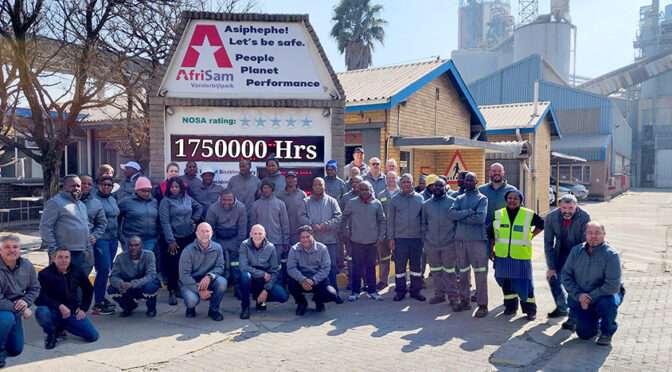
Leading construction material supplier, AfriSam celebrated a significant milestone at the company’s Vanderbijlpark Slagment Operation when it achieved 1,75 million Lost Time Injury (LTI) Free hours earlier this year, demonstrating the high safety standards upheld at this plant. This means that the plant has been injury free for nine years.

As one of the leading players in the supply of aggregates, cement and concrete readymix, AfriSam is committed to safe operation at all its facilities. A strong commitment to ongoing training of its people as well as visible felt leadership underpins the company’s approach to safety and has clearly borne fruit at the Slagment Operation.

AfriSam’s Vanderbijlpark Slagment Operation has the capacity to produce over 700 000 tonnes of slagment per year.

The origin of this operation, situated in the industrial area on the outskirts of Vanderbijlpark, dates back to the 1950s when Dr Niko Stutterheim thoroughly researched the suitability of South African slag for manufacturing cement and for use in concrete. His conclusion that the slag was eminently suitable led to the establishment of the company Building Binders Ltd, which was subsequently registered as Slagment Limited in 1960.

Today, this operation still produces slagment and supplies the product to operations within AfriSam as well as to other customers for the manufacture of blended cementitious products.

Slagment is the registered trade name for Ground Granulated Blast Furnace Slag (GGBFS) and is a by-product of the iron- and steel production process. It is a latent hydraulic binder that is used in concrete and other construction applications as a partial cement replacement material. Due to its cementitious properties and depending on the application, slagment can replace up to 70% of Portland cement in concrete, enhancing quality in both fresh and hardened states.

AfriSam is committed to safe operation at all its facilities.

AfriSam’s Vanderbijlpark Slagment Operation has provided slagment for over five decades for the construction of major structures including buildings, dams, bridges, roads and water-retaining structures. The factory has the capacity to produce in excess of 700 000 tons of slagment as well as over 200 000 tons per annum of blended cementitious products.

Some noteworthy projects built with slagment from AfriSam include the Ben Schoeman Highway, the South African Reserve Bank and the Gariep Dam on the Orange River.

AfriSam has long been at the forefront of initiatives to reduce carbon emissions, and this has included leveraging extenders in its composite cements, leading to a substantial reduction in its clinker factor without any compromise on product quality. David Labuschagne, AfriSam Slagment Plant Manager says that key among these extenders is blast furnace slag, a by-product of the steel industry.

“Clinker substitution is not new, but there is a growing trend within South Africa to use more environmentally friendly concrete design mixes that use fly ash or slag.,” he says. Interestingly, the Association of Cementitious Material Producers (ACMP) noted that clinker substitution rose from 12% in 1990 to 41% in 2009, with the industry aiming for a 60% rise by 2030.

AfriSam’s Slagment Operation played a pioneering role in introducing separately ground slag for construction applications, and this plant continues to produce slag. The company sources its raw material from ArcelorMittal South Africa, strategically located near the plant.

The benefits of using blast furnace slag are numerous. It offers enhanced strength and durability and is beneficial in decreasing limestone mining and clinker production, thereby reducing carbon emissions.

“By using a finely tuned mechanical activation method, AfriSam has obtained a more reactive product, enabling the progressive replacement of clinker while maintaining high cementitious quality and strength performance,” Labuschagne says.

With its ongoing commitment to sustainability and innovative strategies, AfriSam continues to pave the way in creating eco-friendly products without compromising on quality.

CAPE INTERCHANGE UPGRADE GETS AFRISAM TREATMENT

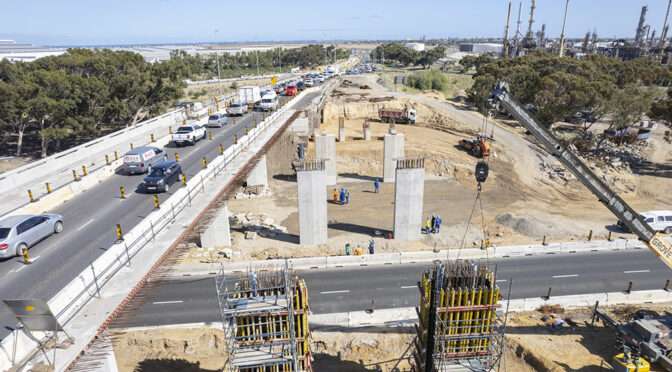
Since July 2021, well-established Cape contractor Haw & Inglis Construction has been proceeding apace on the upgrade of Cape Town’s Refinery interchange, supported by construction materials from AfriSam.

Apart from extending the width of the bridge, the height has also been raised.

The project is due for completion in early 2024, delivering two new higher and wider bridges over the busy N7 highway – a new road-over-rail bridge alongside the existing bridge which receives rehabilitation works and the upgraded access ramps among the key achievements.

Leiton Chan, Construction Manager at Haw & Inglis Construction, highlights that due to capacity and height limitations of the existing bridge, the new bridges double the capacity and provide an additional 1,7 m clearance from the existing bridge for vehicles travelling on the N7. To accommodate existing traffic, the westbound carriageway was constructed alongside the existing eastbound carriageway. Once completed, the traffic was diverted onto the new carriageway to complete the eastbound carriageway. The existing bridge was demolished in December 2022 to make space for the new bridge – currently under construction.

The readymix is supplied from AfriSam’s Contermanskloof plant, with back-up plants nearby in Woodstock and Belville.

“Each bridge deck over the N7 was cast in two, consisting of a dual spine, post tensioned structure,” explains Chan. “The project is currently on schedule, with the estimated completion date for the East bound carriageway bridge over the N7 being August 2023.”

AfriSam is providing around 6,300 m3 of readymix concrete as well as material for layer works, according to Bradley Thomas, Territory Sales Manager at AfriSam. The company is also supplying some 15,000 t of aggregate to the project’s asphalt supplier, Much Asphalt.

“An important application of our readymix was for the piling under the bridges, which required almost 1,500 m3 of high strength 40MPa concrete for this purpose,” says Thomas. “A priority here was to avoid any jointing in the piles, so it was essential that each pour – about 3,5 m3 per pile – was continuous.”

One other element of the project is the realignment of the interchange’s five access ramps to suit them to the upgrade bridge structure.

He notes that the decks on the two main bridges over the N7 also require continuous pours, amounting to substantial volumes of 500 m3 of W50 MPa concrete per deck. Placement is carried out using a high capacity 36 m boom placer. The readymix is supplied from AfriSam’s Contermanskloof plant in Durbanville, located 8 km from the site, with support from the company’s other nearby plants at Woodstock and Bellville.

The spreading of supply sources allows for further mitigation of project risk related to readymix deliveries, says Thomas. For instance, large continuous pours leave little room for error, and unforeseen events such as traffic congestion have to be factored into the resource planning.

“On the smaller scale aspects of the project’s readymix requirements, our flexibility also allows us to effectively supply the smaller sub-contractors on the project,” he adds. “We have therefore also been able to play a role in enterprise development, supplying the kerb mix to SMME contractors installing the precast kerbs.”

For the road work, AfriSam is supplying about 50,000 t of aggregate for layer works from its Contermanskloof quarry. According to Chan, Haw & Inglis Construction has been able to incorporate a considerable amount of recycled material in the road fill. He points out that the westbound carriageway fill was made up of in-situ G7 sand material excavated from the bridge and mixed with recycled asphalt product (RAP). The RAP is milled material from the various road contracts conducted by the Western Cape government.

In addition to carefully facilitating the traffic flow through the interchange during construction, the project has also had to navigate underground and overhead services from high voltage power lines and diesel pipes to sewer networks and optical fibre lines, he says. A further environmental priority was not to disturb two small wetlands within the road reserve.

SUPPORTING CONTRACTORS’ GREEN AMBITIONS

With the trend towards green buildings, contractors are expected to support their customers in reaching sustainability goals; AfriSam’s product range has been evolving with this front of mind.

Decades of innovation in terms of environmental responsibility and carbon reduction have put AfriSam out front, according to Hannes Meyer, Cementitious Executive at AfriSam. The company was one of the first to develop its own sustainability road map, and this is now paying off for customers.

“The sustainability drive in the construction sector is gathering momentum,” says Meyer “The carbon footprint of construction materials is where contractors can make immediate gains when looking to align a project with more stringent environmental standards.”

The company’s manufacturing processes are among the most energy efficient in the sector.

Meyer points out that the company has made continuous progress in fields such as energy efficiency, cement extenders, water conservation and biodiversity. This allows customers to procure products in the knowledge that the environmental and carbon impact is minimised. 

“We give our customers the opportunity to support a more sustainable future for the sector by choosing construction materials that embody this commitment,” Meyer explains. “We do not just set theoretical targets for environmental performance; we are practical about what we can achieve, because we have been innovating on this front for so long.”

This is in clear contrast to a significant level of ‘green-washing’ in this sector, where many companies advertise a sustainable approach but without credible evidence of how their targets are to be achieved. Since 1990, AfriSam has been able to reduce the volume of carbon dioxide emissions per ton of cementitious material by 33%.

In a carbon-intensive industry like cement manufacturing, it is difficult to reduce the carbon impact without a depth of expertise and constant investment in innovation, says AfriSam Process Engineer Marieta Buckle. It is also important to consider the cost implications of any changes, given South Africa’s need for a just transition to a sustainable future.

“In our position as a developing country, our future will demand the construction of millions of houses – structures that require considerable quantities of cement,” says Buckle. “The way we pursue our just transition must take into account the affordability of these homes for the vast majority of citizens.”

AfriSam has therefore been cautious in how it sets and publicises its sustainability targets, while all along continuing to prioritise research and development into how to achieve lower carbon products. Having considered a wide variety of options available, it has implemented strategies that have the least cost impact on customers and the market. 

CUTTING CARBON EMISSIONS WITH CEMENT EXTENDERS

The science of substituting clinker in cement with a portion of alternative cementitious materials has paved the way for substantial gains in decarbonisation.

According to AfriSam process engineer, Marieta Buckle, the company has reduced its carbon dioxide emissions per ton of cement by 33% since 1990. An important factor in this sustainability journey has been the use of extenders – mainly fly ash and granulated blast furnace slag.

“We have been on this journey for many years before buzzwords like ‘net zero’ were in common use,” says Buckle. “Our Project Green Cement began in 2000, involving significant research and development being invested; among the outcomes, we were able to launch our Eco Building Cement in 2010 as the lowest carbon footprint product.”

AfriSam launched Project Green Cement in 2000 as a concerted effort to produce more environmentally responsible cement.

AfriSam became arguably the world’s first construction materials supplier to ‘carbon footprint’ all our production operations, including cement, aggregate and readymix concrete, she notes. Its carbon dioxide rating system indicates each product’s carbon footprint relative to Ordinary Portland Cement (OPC).

Buckle explains that producing clinker is the most energy intensive aspect of cement manufacturing – and is therefore a prime driver of carbon dioxide emissions. A central strategy at AfriSam has therefore been to promote decarbonisation by reducing the portion of clinker in cement while maintaining its strength and other properties. As an added advantage the utilisation of extenders also enables formulation of cement products that have improved characteristics specific to the application.

“AfriSam’s extensive research and development effort has been able to develop a cement mix that comprises up to 70% of alternative materials,” says Buckle. “Such a mix would contain only 30% of clinker while still providing the required cementitious properties for the application. Importantly, it consumes less energy – and generates fewer carbon emissions – in the production process.”

AfriSam has reduced its CO2 emissions per tonne of cementitious material by 33% since 1990.

Its ongoing achievements in this field are reflected in the statistics. AfriSam’s carbon emissions per tonne of cement produced is – at 598 kg in 2021 – is considerably lower than the 671 kg average among South African cement producers, measured in 2016. It is lower, too, than the global average of 642 kg of carbon emissions per tonne of cement.

“By using what are essentially waste materials like fly ash and slag, we can leverage the energy that has already been consumed in generating them as by-products,” she says. “Apart from the value of recycling a waste product, we can make our cement production gradually more sustainable by reducing the energy that is required.”

CONSTRUCTION SECTOR WAITS FOR GAME CHANGING ACTION

The outlook for South Africa’s struggling construction industry remains uncertain, hovering between the massive infrastructure expenditure figures being publicly mooted and the state’s seeming inability to implement its economic recovery plans. 

At this year’s AfriSam Budget Breakdown event, now a regular highlight on the construction sector calendar, Econometrix Economist Dr. Azar Jammine pointed to raised expenditure targets for infrastructure. Dr. Jammine said he was encouraged by the growth from R812 billion to R903 billion in the estimates for public sector infrastructure expenditure from the 2023/24 to 2025/26 financial years. 

Richard Tomes, AfriSam's Sales and Marketing Executive.
Richard Tomes, AfriSam’s Sales and Marketing Executive.

“These numbers are so big that if we were to see their full implementation, it would be a game changer not only for the construction sector, but for the entire economy,” he said. “Where the real hope lies is in government getting its act together and starting to implement its capital projects.”

He noted the importance of how Finance Minister Enoch Godongwana dealt with plans to restructure Eskom’s capital debt, as any worsening of the energy crisis could undermine the economic predictions in the budget speech. If loadshedding was exacerbated, he felt that the country may not even reach its meagre 0,9% growth target for the year. In such a scenario, government’s own spending plans would be further dampened by lower tax revenues. 

The question he posed was whether there was the political will within the governing party to allow Eskom’s debt restructuring to take place. Such a move was inevitable, however, as he foresaw a complete realignment of politics in the general elections of 2024.

Focusing on the construction industry, Dr Jammine once again painted a sobering picture – but highlighted the sector’s potential to deliver economic benefits. He reminded his audience that construction provides 7,8% of the country’s employment, even though it makes up just 2,6% of GDP.

“Implementing government’s infrastructure projects would spark massive job creation, and the economy would grow by 5-6% a year,” he said. As it was, business confidence among building contractors continued to deteriorate, although last year this deterioration had slowed. 

Dr Azar Jammine, Econometrix Economist at the AfriSam Budget Breakdown event.

Commenting on Dr Jammine’s presentation, Richard Tomes, Sales and Marketing Executive at AfriSam said: “Although the operating environment remains challenging, one of the positive elements AfriSam has noted is the increase in the infrastructure spend budget allocation, and we remain hopeful that the implementation of the infrastructure projects will gain momentum and start delivering true value for the construction industry.” 

Considerable overcapacity was still evident in the non-residential building sector, especially commercial office and retail space. The value of non-residential building plans passed averaged just about R1 billion in value compared to R3 billion in 2016. The brief recovery in the residential building sector – as homeowners renovated for home offices – had tailed off. Cement demand suffered negative growth in 2022, and was expected to improve only marginally over the next few years, he said.

AfriSam SA Budget Breakdown Event

About this annual event itself, Tomes remarked that AfriSam’s purpose is to make valuable information available to the various stakeholders that interact with its business. “With many of us operating in the same industry, material matters such as the external environment we operate within not only relates to AfriSam but also to our stakeholders’ businesses. We hope that the information being shared at an event like this will not only provide them with insight about some of the decisions that AfriSam takes but will also provide them with valuable insights to enable decision-making in their own businesses or organisations to ensure their future success and sustainability.

QUALITY SHORTCUTS NOT GOOD FOR FUTURE OF CONSTRUCTION

Weak economic conditions in construction have led contractors to find new ways of surviving, and some strategies could undermine the longevity of roads and buildings, says AfriSam Construction Materials Executive Avi Bhoora.

Avi Bhoora, AfriSam Construction Materials Executive.

“On the aggregates side, we find that the call for ‘brown’ material – as opposed to the high-value ‘blue’ material like quartzite, tillite and dolomite – is rising,” he says. “While some brown materials can be modified by additives, they cannot match the quality of competent rock.”

In the past, G1 aggregate was the main base course for roads, with G2 as the sub-base, and G4 and G5 used for the selected layers. Bhoora says that recently there are efforts to substitute these, using products with names like G4A or G4A Special, for instance. Specifications are being adapted possibly because of cost pressure, but have not yet stood the test of time.

“During my 40 years in construction, I have been involved in projects building roads that have outlasted their expected 25 year lifespan by a decade or more,” says Bhoora. “It is uncertain whether the new specifications will be as effective, especially with the much heavier loads on our roads today. My personal view is that going this route might be short sighted in the long run.”

AfriSam has long been known as a specialist in high strength readymix products.

In terms of the readymix market, he says the average strength of concrete supplied has been gradually declining. AfriSam has long been known in the sector as a specialist in high strength products for demanding applications like high-rise buildings – with concrete strengths up to 100 MPa for high-rise projects.

“There are fewer projects like this currently, but there are also signs of users ‘buying down’ when it comes to readymix,” he says. “Whereas 35 MPa was the average strength we supplied until recently, that average is now closer to 28 MPa. This is concerning, as skimping on concrete strength is certain to have long term consequences for buildings’ longevity.”

He notes that there is still insufficient work entering the project pipeline throttling, holding back the potential of the construction sector to create jobs and build valuable infrastructure. Contractors and their supply chain remain under pressure, with low margins leading to the demise of amalgamation of important industry bodies.