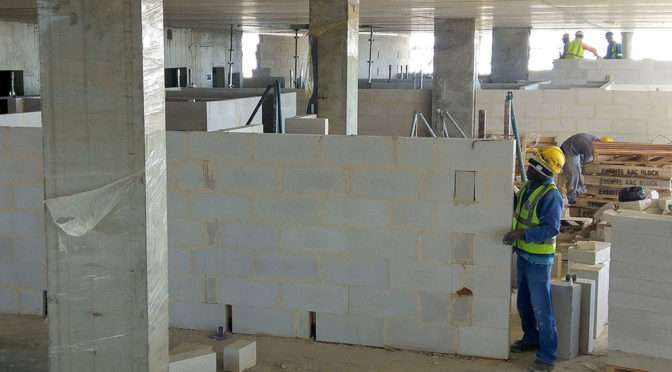
EFFICIENCY A KEY DRIVER IN ENVIRONMENTAL STEWARDSHIP

Demanding economic conditions – aggravated by stoppages caused by the Covid-19 pandemic – have highlighted the value of environmental stewardship in the construction sector.

“A key focus of good environmental stewardship is on project efficiency,” says Bruce Paul, environmental manager at Concor. “It is vital that contractors develop end-to-end engineering processes that conserve resources and manage risk – now more than ever.”

Before construction on a project even starts, Concor considers issues including material sourcing, reduction of potential wastage, and the carbon footprint of fuel and materials. The company recently took the opportunity, for instance, to reduce the use of water, sand and cement on a Gauteng building project.

“This interesting innovation was applied by constructing the inner wall with everite-hebel autoclaved aerated concrete (AAC) blocks, which are lightweight,” says Paul. “While a typical brick and mortar wall weighs about 350 kg per square metre, an AAC wall load is about 90 kg per square metre. Requiring a thinner skim coat finish, this positively impacted our material and logistical demands for less water, sand and cement.”

The building’s long-term energy efficiency was enhanced with the use of performance glass which has a low-e aspect, reflecting long wave infrared energy and helping to keep the building cooler. This, in turn, reduces the load on the air conditioning system.

He emphasises that judicious use of water is also an ongoing environmental concern for contractors, especially in water-scarce countries. In a building project in Botswana, Concor had to find solutions when a moratorium was placed on all non-drinking uses of municipal water. The porous rock in the foundations proved to have a constant outflow of irrigable water. This was pumped to a farm of tanks on site and reused for purposes such as dust control and the mixing of mortars and plasters. The end-design of the building was even adapted to make use of this source for its the brown water system.

A recent building project in Cape Town also required working within strict municipal water restrictions. Alternative water supply for building operations was sourced from groundwater below the foundations. It was non-potable but could be used for certain aspects of the building. Monthly municipal water usage at the site dropped from 60,000 litres to 5,000 litres within just a few months.

On a wind farm project in the Western Cape, Concor ensured that all secondary water was cleaned and diverted back to construction process.

“Water use on construction sites often comes from concrete-related processes such as the washing of readymix trucks,” he says. “We were able to remove solids such as aggregate for re-use, while returning the water to the batch plant. With this water’s cementitious content, it could also be used in the compaction of roads and building up of road layers.”

Paul highlights the growing but necessary weight of environmental licencing that applies to both the end-client and the contractor. Complying with the requirements of the various licences – from water use and air quality to cultural heritage and protected species – requires expertise and agility.

“Effective stewardship demands a comprehensive suite of practices to prevent and mitigate any pollution that may emanate from our industrial processes,” he says. “We apply this knowledge across all projects, according to our critical environmental standards to manage risks and make the most of opportunities in each case.”

AFRISAM MAKES A CONCRETE CONTRIBUTION TO THE LEAP SCHOOL IN DIEPSLOOT

In a partnership that started in 2014, AfriSam has donated construction materials for the construction of the new LEAP Maths and Science School in Diepsloot, Gauteng.  AfriSam was approached by one of the main sponsors of the school, Aveng Infraset, to support this initiative through the donation of cement and readymix products.

Established in 2011, the LEAP School is attended by over 200 children from the impoverished Diepsloot community, and until now they have had to attend their classes in rented space in a converted warehouse. 

On Tuesday, 14 July 2020, the school celebrated the opening of its new campus during a virtual launch event. The new purpose-built school campus now boasts 11 classrooms, a learning centre, library, computer centre, administration block and a community hall.

“We are extremely grateful to AfriSam for the invaluable role they have played in making our dream a reality. They have made a positive contribution to the education of our youth and future leaders of South Africa”, says John Gilmour, LEAP Executive Director & Founder. 

During the construction phase of the project, AfriSam donated 150 tons of its Dry Mortar mix for bricklaying and plastering, 840 bags of its All Purpose Cement used in the rammed earth construction method as well as 119 m³ of readymix concrete for foundations and other structural elements.

AfriSam prides itself on making a positive contribution to local communities in areas within which it operates. “AfriSam operates a number of quarries in the area, and we were excited to get involved in this worthy initiative. The focus in this area is to understand the needs of communities and make meaningful and sustainable contributions to their upliftment”, says Amit Dawneerangen, AfriSam Readymix General Manager.

The product donation for the construction of the LEAP school in Diepsloot is in line with the company’s corporate social investment focus of education and youth development. The company is involved in various educational projects, with the aim of empowering and equipping communities with the necessary knowledge and skills, as well as providing them with the tools and facilities to become self-reliant and sustainable.

“On behalf of AfriSam, we would like to congratulate the LEAP School on the completion of their new school campus. We are proud to be associated with such a beacon of hope in the community. We wish the teachers and learning at the LEAP School all the best. Happy learning!” Dawneerangen concludes.

BOOYCO CONTINUES TECHNOLOGY DRIVE DESPITE COVID-19

While the Covid-19 lockdown has forced many companies serving the mining sector to downscale, Booyco Electronics is continuing to apply and develop its technologies for safer, more productive mining operations.

With its nationwide team of some 180 field technicians serving opencast and underground mines – by far the largest footprint among players in this field – the proximity detection specialist has remained hard at work. While supporting those coal mines that worked through Level 5 and Level 4, the company has also been assisting customers to ramp up to full production after the initial stoppage.

According to Booyco Electronics chief executive officer Anton Lourens, the lockdown has even given his engineering team some welcome breathing space for their technology development. With collision avoidance standards in mines becoming stricter, technology is responding rapidly.

“Our plans to grow our engineering team from 18 to over 30 experts this year remains on track, giving us added capacity to meet industry needs,” says Lourens. “Even under lockdown restrictions, this expanding team has continued its work on new features and functionality for our products.”

The move to the Level 4 lockdown allowed opencast operations to resume and underground mines to move to 50% production. Booyco Electronics was on hand to assist with the required pre-start inspections and equipment checks, which then accelerated with the relaxation to Level 3.

“While the lockdown restrictions were disruptive to everyone, we have learnt valuable lessons and increased our efficiencies over recent weeks,” he says. “This has left us stronger and better prepared to support customers in the field.”

Lourens says the company has not rushed to bring employees back to its offices in Level 3, taking the safer route of allowing only one third back in June. Where employees were not required to physically touch a product, they continued to be deployed at home.

“To date, we have used the lockdown as a valuable opportunity for training and refresher courses,” he says. “It has also been vital to communicate constantly with staff and entrench our safety procedures for future continuity.”

Lourens warns that the lost production on mines will mean heightened pressure on the correct implementation of collision avoidance strategies. The anticipation of tighter safety regulations had led many mining companies to target the end of 2020 for proximity detection upgrades.

“In these tough economic times – and with time lost due to Covid-19 – mines cannot afford to get it wrong when executing projects to apply these technologies,” he says. “Detailed planning will be vital in defining and implementing each mine’s specific collision avoidance solutions. The 2020 deadline may now in fact be very difficult for many mines to meet.”

WORKING TOWARDS UNDERGROUND RESOURCES AT OTJIKOTO MINE

Vancouver-based B2Gold plans to conduct mining of the Wolfshag zone at its Otjikoto mine in Namibia and has appointed Murray & Roberts Cementation in joint venture with Lewcor Mining to establish the underground stoping horizon.

According to Allan Widlake, new business director at Murray & Roberts Cementation, mobilisation on site has begun and the contract will take 28 months. Otjikoto Mine is Namibia’s largest gold producer and has been in operation since 2015. The Wolfshag zone at Otjikoto comprises a series of shallow, easterly dipping mineralised shoots that sub-crop below calcrete cover, plunging for a strike length of at least 1,600 metres.

The contract will see a decline of 5 metres wide by 5,5 metres high being driven to the orebody from a portal in one of Otjikoto’s depleted open pits. There will also be two 4 metre diameter ventilation shafts created using raiseboring methods. One will measure 200 metres in depth, and the other 80 metres.

“We will be conducting this project in a strategic partnership with a highly professional local Namibian opencast mining and earthmoving contractor, Lewcor Mining,” says Widlake. “Lewcor is an existing service provider at Otjikoto and is well-regarded by the client and the industry.”

He says the operation will be highly mechanised and efficient, with equipment including drill rigs, dump trucks, load-haul-dumpers and utility vehicles, as well as shotcreting and ancillary equipment. About 150 employees will be active on the project, including a highly experienced crew from a recent contract in Zambia. Most of those involved will be Namibians, who will be trained as part of a special counterpart training programme to transfer skills to local workers.

Widlake says he is excited by the project and the prospect of Namibia offering strategic opportunities in the mining sector, as other mines consider evolving from opencast to underground.

He highlights that Murray & Roberts Cementation is one of very few companies worldwide with the experience and capability to conduct both development work and raiseboring as part of a single package.

“This gives us as the contractor much closer control of our projects, allowing us to reduce our subcontract-related risk,” Widlake concludes.

THE AFRISAM WAY LEADS TO ANOTHER SUCCESS STORY

As a leading supplier of construction materials and technical solutions, AfriSam was instrumental in the successful execution of a project in Spartan, Kempton Park. Working closely with contractor, DM Bodenstein Projects & Construction, AfriSam leveraged its expertise to create yet another concrete possibility the moment the lockdown ban was lifted on construction activity for essential services.

Appointed to undertake a project relating to the transport and distribution logistics for the client, DM Bodenstein Projects & Construction brought its experience on similar and, in fact, larger projects to the contract. The company is owner driven with a solid track record in delivering quality projects on time.

Phase 1 of the project was completed last year and comprised access and security structures. Phase 2, 3 and 4 comprise the construction of three surface beds in the storage yard to carry the static and dynamic loads of containers and heavy delivery vehicles, as well as the installation of fire hydrant lines and sleeving for all services and all paved walkways.

With heavily loaded forklifts with up to 98.17 tons on the front axle, the challenge was to design and construct concrete slabs to carry these loads. The surface beds are only 300 mm thick.

“We believe we secured this contract based not only on our experience and ability to offer a competitive price, but also because we were able, through our relationship with AfriSam, to offer technical solutions that would meet the specific application requirement,” Dewet Bodenstein, director of Bodenstein Projects & Construction says.

This solution was found in a modified AfriSam Surfacebed mix with the addition of Oxyfibre, supplied by CHRYSO Southern Africa. In consultation with the AfriSam Centre of Product Excellence and the technical team from CHRYSO Southern Africa, a high dosage rate of 3 kg Oxyfibre per cubic metre of concrete was determined as the optimum application for these surface beds.

“The project specification called for a 40 MPa concrete, 125 mm slump, with a 22.4 mm aggregate. The addition of the Oxyfibre, with a strand length of 40 mm, required careful monitoring of the slump at all times,” Bodenstein says.

The high density of fibre in the mix necessitated very thorough mixing of the concrete to ensure that the fibres were evenly dispersed. As AfriSam’s readymix plant in Spartan is less than 2 km from the construction site the concrete trucks arriving on site had to stand for another 10 minutes to complete the required mixing time.

Some 1 800 m2 of fibre reinforced concrete was placed using an AfriSam pump, and Bodenstein says that placing the pumped concrete is much easier and faster when the operator does not have to navigate steel reinforcing. In total all four phases will equate to about 7 000 m2.

“Another major advantage of using fibre instead of steel mesh is that the fibre disperses throughout the concrete matrix, facilitating a multi-directional plastic shrinkage cracking reduction matrix,” he explains.

Seven-day cube results achieved 29 MPa, and with appropriate curing the required 40 MPA specified strength at 28 days was achieved. While the cold weather and windy conditions have slowed down the curing process somewhat, it has had no detrimental effect on the placing of the concrete.

“The AfriSam readymix plant’s proximity to the site, coupled with AfriSam’s track record of excellent support service, made the company an easy choice,” Bodenstein says. “And their readiness to supply material at short notice once the lockdown was eased, and the support received from their Centre of Product Excellence and sales representative on site ensured that the project could proceed without a hitch.”

“This is our first experience using Oxyfibre at this scale, and having experienced the advantages and ease of use, we are confident that this is the way of the future for reinforcement.”

Queen Mabunda, territory sales manager at AfriSam concludes: “We pride ourselves on giving excellent service and building lasting relationships to ensure the successful execution of a project. Working with DM Bodenstein Projects & Construction on this project proved once again that supplying appropriate materials, supported by dedicated service is the AfriSam way.”